ASTeC Researchers Develop New Concept for Plasma Acceleration Beam Transport
24 Mar 2026

New focusing concept enables capture of high-energy plasma-accelerated electrons. A new paper led by ASTeC describes a flexible method to capture and perform beam conditioning of GeV-scale laser-wakefield accelerated electrons, and is intended to be constructed at the Central Laser Facility’s new EPAC accelerator platform.
It is well known that laser wakefield acceleration (LWFA) offers an exciting route to the generation of high-energy electrons, and can produce very short (c.10 fs), GeV-scale electron bunches over a tiny distance. However, an intrinsic limitation is that those bunches are also generated with a large divergence, and they must be captured after their acceleration in a suitable beam-conditioning transport system before they can be adequately utilised for experiments. Conventional electromagnetic quadrupoles may be used at lower energies in the 100 MeV scale, but as laser technology advances it is becoming possible to produce electrons in excess of 1 GeV; EPAC is the UK’s new LWFA facility that will produce electrons up to perhaps as much as 10 GeV for a variety of scientific and industrial applications. However, capture and transport of such electrons is made difficult by their much larger beam rigidity.
Prior approaches to capture high-energy LWFA-generated electrons have proposed either permanent-magnet quadrupoles (PMQs) or more speculatively the use of intense electric fields in plasma lenses. In this new paper, a concept is developed proposed by Dr. Bruno Muratori (Accelerator Physics Group), in which an alternating-gradient PMQ channel is used to progressively capture and focus electrons. Perhaps surprisingly, this approach has never been suggested before, and it offers distinct advantages. By interleaving the PMQs, one avoids the undue beam degradation from using lumped focusing such as triplets proposed in other designs. It also allows much more convenient tuning for different LWFA output energies, by reconfiguring the beamline with more or fewer elements.
Even with the new alternating-gradient approach, the PMQ magnetic field gradients that are required are still high, approaching 500 T/m. To achieve this high gradient whilst keeping consistency across magnets, the MARS group (Neil Thompson) developed a new method to tune the overall PMQ gradient; this is done using differing-sized tuning pins in the quadrupole steel pole pieces that can shim the field of one PMQ to match its siblings. A prototype PMQ showed that this method worked, but also exposed a limitation in the NdFeB material that was used; the following series of constructed quadrupoles have used an alternative material that delivers a somewhat lower gradient, but still sufficient for application in EPAC.
Bringing together experts from across ASTeC, CLF and Technology Department, an integrated engineering design has been developed that integrates the new focusing concept into a realisable beamline. This has included in-depth simulations of the variety of electron bunches that may be generated, and a spectrometer and beam-selection system that will be used to energy-select the electrons after conditioning. Subject to project funding, it is hoped that the first sections of beamline will be implemented and commissioned over the next 18 months.
The paper has been accepted 19th March in the open-access journal Physical Review Accelerators and Beams: https://journals.aps.org/prab/accepted/10.1103/8hns-3zqp
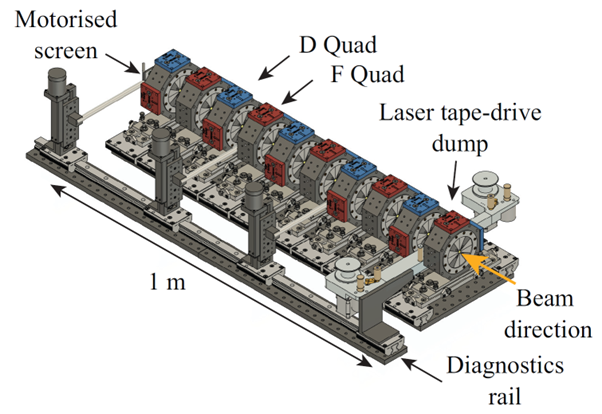
Engineering layout of PMQ capture section to be placed within the EPAC vacuum chamber downstream of the LWFA source. Modular mounting of the PMQs on movers and mounting plates allow convenient re-configuration of the beamline whilst also allowing integration of the diagnostic instrumentation and tape-drive laser dump system.