
ZEPTO: Zero-Power Tuneable Optics
The ZEPTO project is developing a new generation of accelerator magnets that dramatically reduce energy consumption while retaining the flexibility required for modern accelerator facilities. Led by ASTeC at STFC’s Daresbury Laboratory, ZEPTO brings together expertise in accelerator physics, magnet engineering, and advanced manufacturing.

Reimagining Accelerator Magnets for a Sustainable Future
Conventional accelerator magnets rely on continuous electrical power to generate magnetic fields, resulting in significant operational costs and carbon emissions over a facility’s lifetime. ZEPTO seeks to transform this paradigm by combining permanent magnet technology with innovative tuning mechanisms, creating magnets that require little or no electrical power during operation. These permanent magnet systems are to be deployed in future scientific facilities and industrial accelerators.
Why Permanent Magnets?
Permanent magnet technologies offer several compelling advantages:
- Near-zero operational power consumption
- Reduced cooling and infrastructure requirements
- Improved reliability due to fewer active systems
- Lower lifetime operating costs
- Reduced environmental impact
Recent advances in magnetic materials and precision mechanical systems have opened new opportunities to overcome the traditional limitation of permanent magnets: their lack of tunability.
ZEPTO is addressing this challenge by developing practical approaches that provide the field adjustment and operational flexibility required by accelerator users.
Applications
The technologies being explored within ZEPTO could benefit a wide range of accelerator facilities, including:
- Particle physics research infrastructure
- Light sources and photon science facilities
- Medical and healthcare accelerators
- Industrial irradiation and materials processing systems
- Accelerator-driven energy and environmental applications
By reducing operational energy requirements, these technologies have the potential to make accelerator facilities more sustainable and economically attractive.
ZEPTO magnets are already deployed and proven in operation in current accelerators.
A ZEPTO magnet was tested at Diamond Light Source, the UK’s national synchrotron science facility in Oxfordshire. A comparable electromagnet can account for ~136kg of CO₂ emissions per year; the ZEPTO demonstrator installed in August 2022 showed no radiation-induced degradation and saved ~700 kWh/year.
Engineers on the Compact Linear Accelerator for Research and Applications (CLARA) at STFC’s Daresbury Laboratory installed a ZEPTO magnet in 2026. It replaces an existing electromagnet, performing the same function with zero power draw, while maintaining precision and beam quality.
Achieving Tunability Without Continuous Power
A common perception is that permanent magnets offer excellent efficiency but little operational flexibility. ZEPTO is challenging this assumption by developing magnet systems that retain the low-power advantages of permanent magnets while providing a high degree of adjustability.
Rather than changing magnetic field strength through electrical current, ZEPTO exploits the ability to mechanically reconfigure carefully designed arrays of permanent magnets. By altering the relative position and orientation of magnetic elements, the magnetic field experienced by the beam can be increased, decreased, or reshaped as required.
Several complementary approaches are being investigated:
- Mechanical Field Adjustment
- Variable-Gradient Optics
- Hybrid Magnet Concepts
- Modular and Reconfigurable Designs
- Precision Control and Repeatability
These are embedded in the following research areas: Tuneable Permanent Magnet Systems, Accelerator Integration, Novel Magnet Architectures and Modelling, Prototyping and Testing.
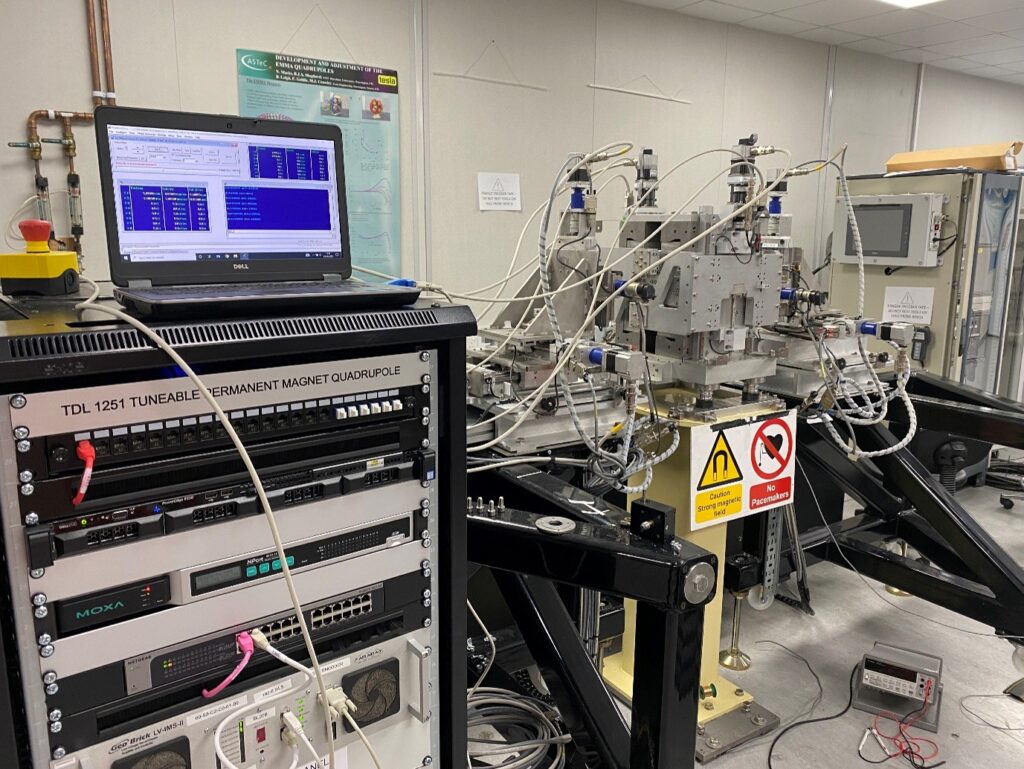
ZEPTO quadrupole testing in ASTeC’s magnet lab

How to get involved
If you would like to collaborate, contribute expertise, or learn more about the ZEPTO project, please contact Martin Bannon.